
Spain has a voluntary labelling system for the packaging of domestic products aiming to inform citizens about the correct separation, and disposal. Interestingly, although it is not mandatory, most of the products available on the market, have information on the correct separation of packaging waste.
Ecoembes, the Spanish non-profit organization that cares for the environment through recycling and the eco-design of packaging, makes an information system available to member companies to help citizens correctly separate the packages.
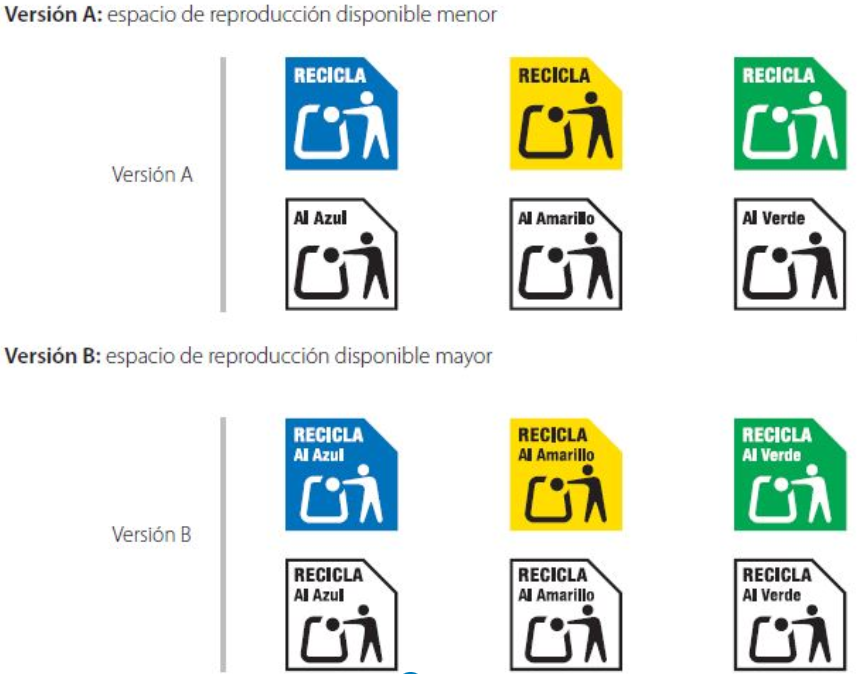
According to this system, there are three types/colors of waste bins (i.e., blue, yellow, and green) available for the selective collection of packaging.
- The blue is intended for paper and cardboard;
- The yellow is intended for plastic, metal, and carton-type containers (milk, juice containers, etc.) ;
- The green is intended for glass.
This recycling symbol could be used in two different versions depending on the space of the packaging:
The position of the symbol on the packaging or on the packaging label is flexible.
In individual packaging, it is convenient to place the symbol on the main element of the packaging (bottle, jar, glass, etc.) or on the label that identifies the product.
For multi-component packaging, made of different materials, it is recommended to use the corresponding symbol on each of the components of the packaging. If this is not possible, the symbol can be used on the main element (bottle, jar, glass, etc.) or the label that identifies the product. The following terms will always be used to define the different materials: Cardboard, Plastic, Metal, and Glass.
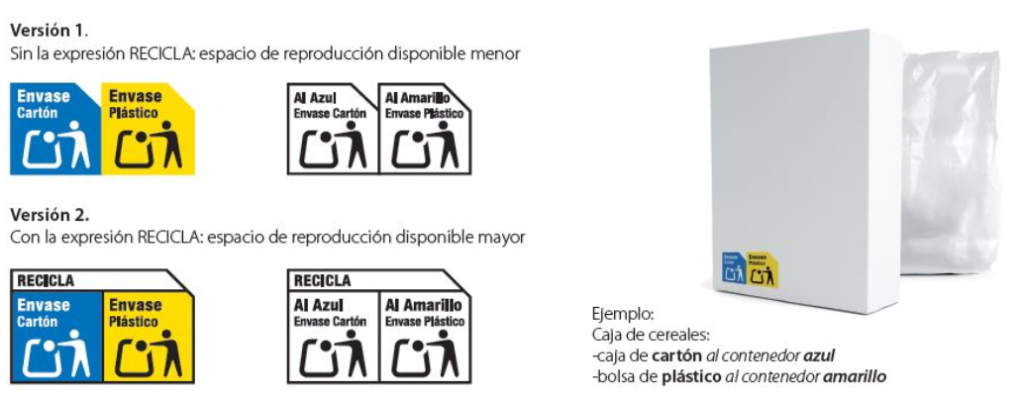
In grouped packaging, it is recommended to place the corresponding symbol on the grouped packaging and on each of the individual packaging that is grouped.
What is more, in terms of the size of the symbol, this should be at an appropriate size that makes it visible to consumers. The minimum allowed dimension is 8 mm.
Differences among Spanish, French, and Italian packaging requirements for environmental labels
Although the aforementioned environmental label is not mandatory for products sold in Spain, products sold in France and Italy should follow specific packaging labeling requirements and bear their own symbols aiming to facilitate waste collection.
- France
- Mandates the use of the Triman logo and the graphical representation of the sorting instructions. This graphical representation includes all packaging components that can be sorted separately after consumption, and thus must be shown separated by a + sign.
- The sorting advice and waste bin can be in green and yellow.
- The green bin is intended for the glass containers, and
- the yellow bin is intended for the other types of packaging (e.g., metal and paper).
- For international products sold also in France, components can be represented by pictograms only, without the corresponding text. This will save some space on the package and facilitate the potential demand to translate the content of the labeling into all languages of the countries where the products are sold.
- Very small parts of a package (e.g., bottle caps) could stay on the main body of the package to prevent littering regardless of its material. Larger components (e.g., jar lids) should be explicitly labeled separately if they are made of a different material.
- Italy
- Mandates each packaging component that can be separated by hand to have the packaging material’s identification code under Decision 129/97/EC and information on the separate waste collection. Thus it is advisable to:
- specify the wording “Collection (main material family by weight)” or
- indicate the main material family by weight, accompanied by the wording “Separate collection”, and invite the consumer to check the provisions of his or her Municipality.
- The above-mentioned wordings and other visual elements for waste bins can be in specific colors facilitating the waste collection.
- The blue is for paper,
- brown for food waste,
- yellow for plastic,
- turquoise for metals,
- green for glass, and
- grey for unsorted waste.
- The wording that specifies the waste collection based on the packaging material should be in the Italian language.
- Every component that can be separated by hand regardless of its size should be sorted separately.
- Mandates each packaging component that can be separated by hand to have the packaging material’s identification code under Decision 129/97/EC and information on the separate waste collection. Thus it is advisable to:
However, note that all of these environmental labels (for Spain, France, and Italy), can be alternatively displayed in black and white.