
A new requirement for environmental labelling is compulsory for products sold in Italy, according to the Legislative Decree No. 116/2020 dated 3 September 2020. In order to provide companies with useful information on this subject, CONAI had drawn up its own Guidelines and an interactive online tool called e-tichetta (available either at CONAI or directly at e-tichetta.conai.org).
Timeline
On 28 Feb 2022, Law 15/2022 (conversion into law, with amendments, of the decree-law 228/2021) postponed the application of the environmental labeling to 1 January 2023.
The first application date was on 1 January 2022, and then moved to 1 July 2022, and finally postponed to 1 January 2023.
Products that do not meet the requirements and have already been sold or labelled as of 1 January 2023, can be sold while stocks last.
Requirements
Each packaging component that can be separated by hand must bear at least:
- The packaging material’s identification code under Decision 129/97/EC.
- Information on the separate waste collection when this is not indicated on the outer presentation packaging. It is advisable to:
- specify the wording “(main material family by weight) Collection”, and in Italian this is "Raccolta (Carta, Plastica, Vetro) or
- indicate the main material family by weight, accompanied by the wording “Separate collection”, and invite the consumer to check the provisions of his or her Municipality and empty the packaging. In Italian this is "Raccolta differenziata. Verifica le disposizioni del tuo Comune. Svuotare l’imballaggio".
These are the wordings suggested by CONAI; nevertheless, the legislation does not stipulate precise wordings but recommends that packaging is appropriately labelled, with a view to achieving the objective. Note that the wording should be also in Italian.
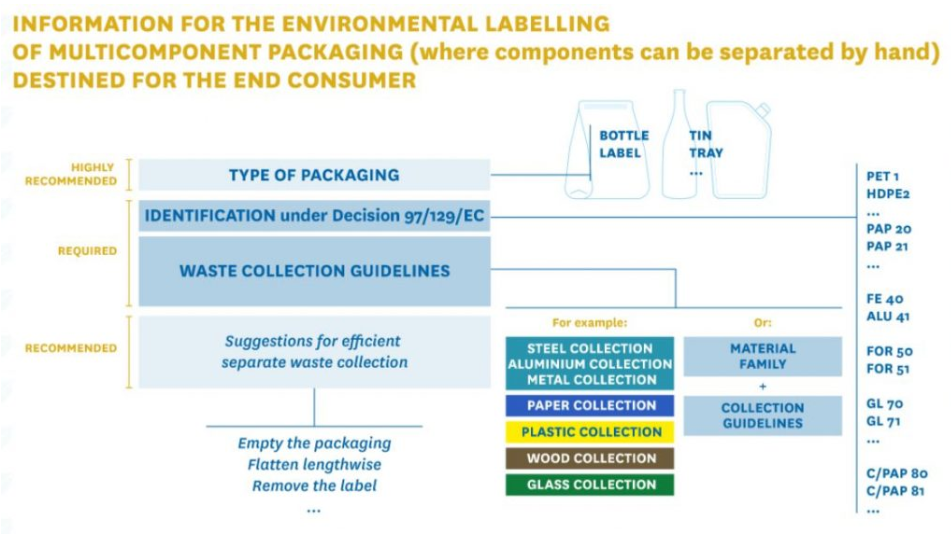
When it is not possible to indicate the relevant identification code on each individual component, for example, due to a lack of space or other technological constraints, this may be stated on the main body or on the presentation packaging.
In the event of placing all the environmental labels on the outer packaging, it is recommended to use the following format:
- Type of packaging (full written description or graphic representation) of the various components that can be separated by hand;
- Identification code of the packaging material of each component that can be separated by hand under Decision 129/97/EC;
- Collection guidelines, clearly specify the material family of each component.
Also, in this case, voluntary information may be provided to help the consumer separate waste efficiently.
Most frequent questions
1) What to do with components that cannot be separated manually?
Packaging systems that envisage a main body and other ancillary components that cannot be separated manually (e.g. adhesive labels, non-separable caps and closures, windows), must indicate the identification coding of the main body material, and collection instructions (which follow the main body material).
Where possible, only the identification coding of the material can be affixed to the components that cannot be separated manually, as per Decision 129/97/EC, but the collection instructions must not be indicated on them. If the packaging system envisages components that can be separated manually from the main body, each of these must indicate the alphanumeric code as per Decision 129/97/EC and the collection instructions.
2) When is packaging defined as a composite? How should it be labelled?
Packaging is defined as composite when it is made up of different packaging materials which cannot be separated by hand. Such packages may be the result of processing (coating, metallic treatment, rolling, lacquering) or laminating techniques.
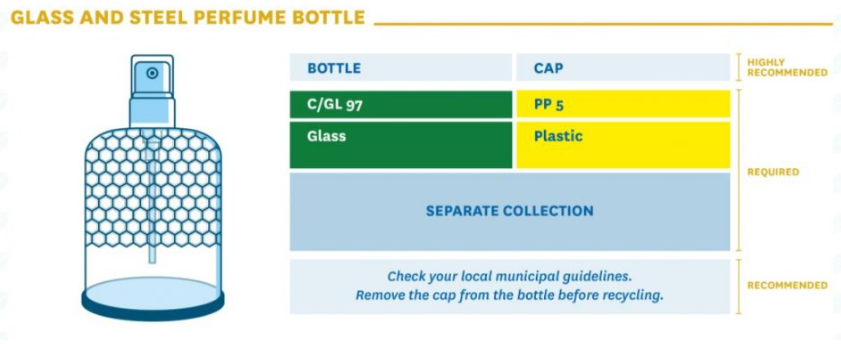
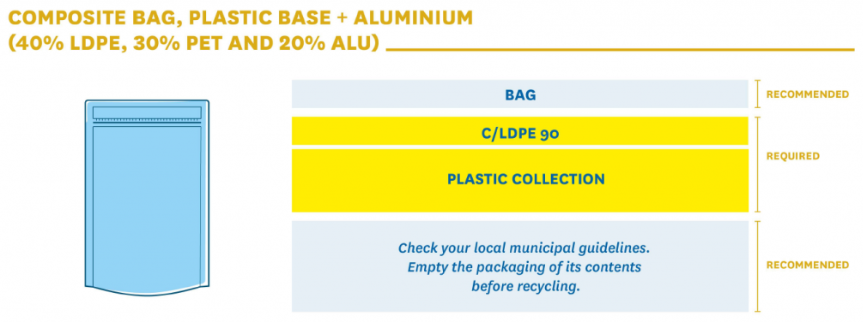
For the purpose of identifying the packaging material, the codes under Annex VII to Decision 129/97/EC are only affixed on composite packaging when the secondary packaging material exceeds 5% of the total weight of the packaging; otherwise, the code to be used is not that provided for in Annex VII but that of single-material packaging, based on the material prevailing in weight. In particular, the coding of composite packaging envisages: C/ main material abbreviation and number associated with that specific coupling (below there are some examples).
Glues, adhesive, ceramic, rubber and inks should not be taken into account in the identification coding.
Example 1
Example 2
3) Should small, multilingual, and imported packaging also be labelled?
The legislation does not provide any exemption for small packaging, and/or that with reduced printed space, or for multilingual or imported packaging.
Nevertheless, for these cases, there are often operational difficulties in providing for the physical affixing of environmental labelling on the packaging, particularly for small packaging, for which, if in a multipack, the way forward might be to affix the environmental labelling on the presentation packaging, but when sold separately, there may be physical limitations for affixing the environmental labelling, and/or difficulties regarding the visibility and legibility of the information.
In this regard, in a note dated 17 May 2021, the Ministry of Ecological Transition clarified that where actual physical and/or technological limitations to physically affixing environmental labelling to packaging are identified, such information may be conveyed through digital channels or, where this route is also not feasible, it must be made available through the company’s and/or reseller’s websites.
In order to make the mandatory environmental information on the composition and proper end-of-life management of packaging more easily available for the end consumer, it is suggested that clear indications are provided on the packaging or at the point of sale on how the consumer can search for this through digital tools or websites.
4) What is meant by a small packaging?
The law stipulates an unambiguous definition of small packaging; however, the note issued on 17 May 2021 by the Ministry for Ecological Transition makes reference to the definitions of small packaging already used by law-makers regarding specific supply chains, such as those for food and hazardous substances. These regulations define small packaging as follows:
-Packaging with the largest surface less than 25 cm2 - a definition which is taken from EU Reg. No. 1169/2011, which indicates the requirement to state the nutrition information of the contents on food packaging and which provides for the possibility of exemption from the requirement for small packaging that meets this definition;
-Packaging with a capacity of up to 125 ml – a definition taken from the CLP Regulation (EC Regulation no. 1272/2008), Article 29, paragraph 2 and Point 1.5.2 of Part I of Annex I), which stipulates that substances classified as hazardous and contained inside packaging must be provided with a label listing specific elements, and considers certain exemptions to this requirement for small packaging that meets this definition.
5) Does the content of the environmental label need to be printed directly on the packaging or can it be placed on a medium (e.g. a separate label)?
The content of the environmental label may be applied/printed/embossed directly on the packaging or placed on a separate medium if this is made possible by the packaging system in question.
6) Should non-packaging accessories enabling the use of the product (e.g. straws, cutlery) be labelled?
As such accessories are not packaging, they are not subject to the labelling requirement, but the packaging containing them is.
7) Is the producer bound by a specific graphic design for its environmental labels?
The graphic designer is free to choose the style, shape and colours of the environmental label: the regulations don’t specify these aspects, but they do recommend that packaging be appropriately labelled in such a way as to achieving the required goal.
More information on the packaging labelling requirements can be found in the Italian Consortium of Packaging Materials (CONAI's) guide.